Conditions / Snoring
Snoring
Snoring is often a sign that air isn't moving freely through the upper airway during sleep. The muscle tone of the tongue, soft palate, and throat matters as much as the anatomy.
Reviewed by Gina Sabbak, RDH · Myofunctional Therapist, Louisville KY. Last reviewed . Educational content — not a substitute for in-person evaluation.
What it is
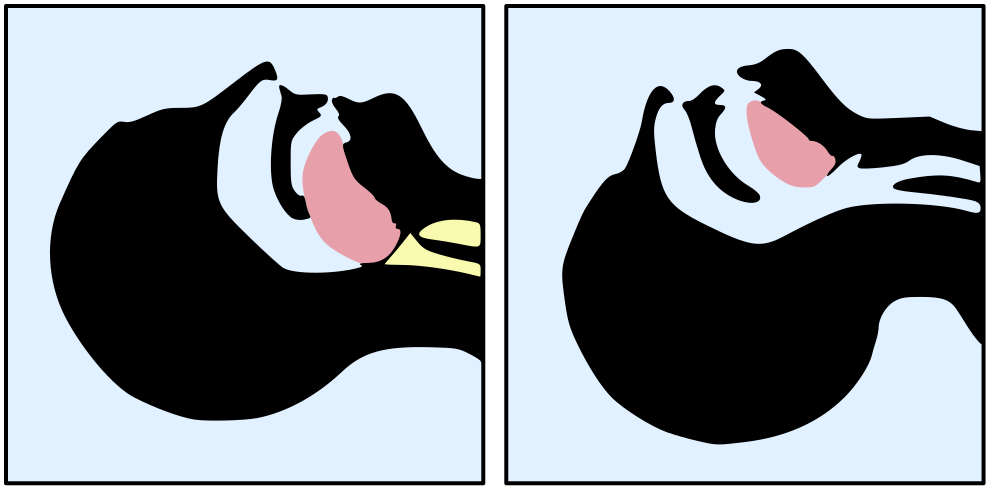
Snoring is the sound of soft tissue vibrating as air moves through a partially narrowed airway. Causes range from nasal congestion to enlarged tonsils to tongue position during sleep.
Snoring is not the same as sleep apnea, but it can be on the same spectrum. Persistent loud snoring warrants a conversation with your doctor.
Common signs
- Loud or habitual snoring
- Gasping or choking sounds during sleep
- Daytime sleepiness despite adequate hours
- Mouth breathing during sleep
- Restless sleep / frequent waking
How myofunctional therapy may help
Educational, not diagnostic. Outcomes vary; results are not guaranteed.
Strengthen the tongue, soft palate, and upper-airway muscles through targeted exercises.
Retrain the tongue to rest in the high posture that keeps the airway more open.
Address mouth breathing that contributes to airway vibration.
What to expect
A typical program runs 3–6 months.
Some adults notice reduced snoring within the first 4–6 weeks.
For sleep apnea, therapy is part of a multi-disciplinary plan, not a substitute for CPAP or oral appliance therapy.
Keep learning
Related reading
- Snoring vs sleep apnea: what the difference is
Educational article (~5 min read).
- Sleep & Airway-Focused Therapy
How this service supports this condition.
- All conditions we work with
The full set of myofunctional patterns we support.
- How we may help
Overview of the assessment and program structure.
Common questions about snoring
- Is snoring the same as sleep apnea?
- No. Snoring is the sound of soft tissue vibrating as air moves through a partially narrowed upper airway. Sleep apnea is a medical condition in which breathing repeatedly pauses or drops during sleep. Snoring can be a sign of sleep apnea, but many people snore without having apnea. Loud, habitual snoring — especially with gasping, choking, witnessed pauses, or daytime sleepiness — is a reason to talk with a doctor about a sleep study.
- Does myofunctional therapy help with snoring?
- Myofunctional therapy addresses the muscle and posture contributors to snoring: tongue tone, soft-palate tone, tongue rest posture, and mouth breathing. For habit or posture-driven snoring, a course of targeted exercises can reduce how often and how loudly snoring occurs. When snoring is a symptom of obstructive sleep apnea, therapy is part of a multi-disciplinary plan rather than a standalone fix.
- When should I worry about my child snoring?
- Frequent, loud snoring in children is not something to ignore. Children should not regularly snore. Snoring in children has been associated with fragmented sleep, daytime behavior or learning concerns, and disrupted growth in some cases. If your child snores more than occasionally — especially with mouth breathing, restless sleep, or pauses — a conversation with the pediatrician is the right next step, often leading to an ENT evaluation.
- Can mouth breathing during the day cause snoring at night?
- Yes. Chronic daytime mouth breathing often goes hand-in-hand with low tongue posture and reduced upper-airway muscle tone. During sleep, this can mean the tongue and soft tissues fall back more easily and the airway narrows. Addressing daytime breathing and tongue posture is therefore often part of a snoring-focused plan. This work overlaps with our Breathing Retraining (/services#breathing-retraining) and Sleep & Airway-Focused Therapy (/services#sleep-airway) services.
Open references
Where the illustrations come from
The anatomical illustrations on this page are drawn from openly licensed educational sources. We attribute them in the caption; the canonical sources are linked here for anyone who wants to verify or use them.