
tongue-tie
Tongue-Tie and Breastfeeding in Newborns: What Louisville Parents Should Know
Tongue-tie can quietly undermine breastfeeding in newborns. Learn how to recognize it, when release makes sense, and how myofunctional therapy supports recovery.
By Gina Sabbak, RDH · · 8 min read
In this article
- 01.Breastfeeding is a mechanical event. For it to work comfortably and effectively, a baby needs to:
- 02.Open the mouth wide (the "gape") Latch deeply onto the breast, taking in a good portion of the areola Use the tongue to draw the nipple to the back of the palate Create and maintain suction with the tongue and jaw working together Transfer milk with rhythmic tongue and jaw motion
- 03.When the tongue cannot lift well, extend past the gum line, or move laterally, several things can go wrong:
- 04.The first person to call is almost always a lactation consultant — ideally an IBCLC (International Board Certified Lactation Consultant). They can observe a full feed, assess positioning, and identify whether tongue restriction is contributing.
- 05.These signs do not diagnose tongue-tie on their own — many are also seen with positioning issues, supply issues, or other infant conditions. But in combination, they point to the need for a proper functional assessment.
Tongue-Tie and Breastfeeding in Newborns: What Louisville Parents Should Know
If you are a new parent struggling with breastfeeding, you are not alone — and you are not failing. Some of the hardest feeding journeys I see in my Louisville practice start with a baby whose tongue cannot move the way it needs to. This guide explains what tongue-tie (ankyloglossia) actually is, how it affects breastfeeding specifically, what the signs look like in a newborn, and where myofunctional therapy fits before and after a release procedure. My name is Gina Sabbak, and I am a Registered Dental Hygienist and IAOM-trained myofunctional therapist who works with families across Louisville and the surrounding Kentucky communities.
TL;DR
Tongue-tie is a congenital restriction of the tissue (the lingual frenulum) under the tongue that limits the tongue's range of motion. In newborns, it can interfere with the mechanics of breastfeeding — affecting latch, milk transfer, and maternal comfort. The first step is a thorough feeding evaluation by a qualified lactation consultant or IBCLC; the second is assessment by a provider trained to evaluate tongue function, not just appearance. Myofunctional therapy supports feeding before a release (when appropriate) and is essential afterward to help the tongue learn to use its full range of motion.
What tongue-tie actually is
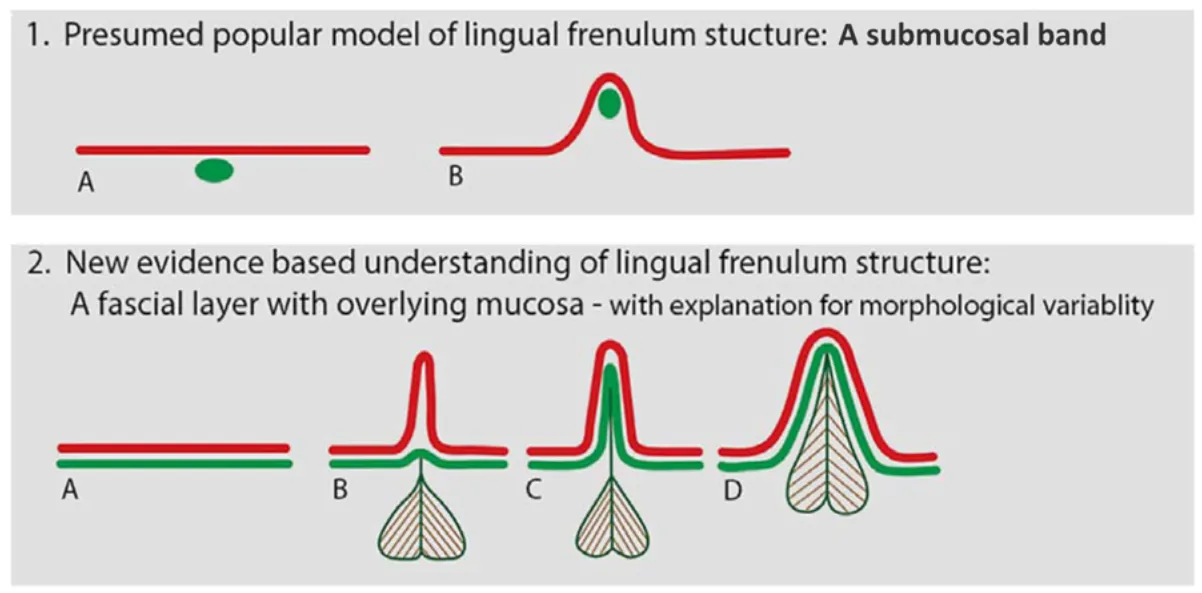
Tongue-tie (ankyloglossia) is present at birth. It happens when the lingual frenulum — the band of tissue that connects the underside of the tongue to the floor of the mouth — is unusually tight, thick, short, or attached too close to the tip of the tongue. The result is restricted tongue mobility, particularly the upward and forward motions a baby needs to latch deeply and transfer milk effectively.
It is more common than many parents realize. Published estimates vary because definitions and assessment methods differ, but research suggests that somewhere between 4% and 11% of newborns have some form of ankyloglossia. Not every case needs treatment; the question is always whether the limited mobility is interfering with feeding, speech development, or other functions.
There are different classification systems — Coryllos, Kotlow's, March — and they each describe different aspects of the tissue. The most useful clinical question is not just what the tissue looks like, but what the tongue can do: can it reach the roof of the mouth, extend past the lower gum line, and move freely side to side? Function matters more than appearance.
How tongue-tie affects breastfeeding specifically
Breastfeeding is a mechanical event. For it to work comfortably and effectively, a baby needs to:
Open the mouth wide (the "gape") Latch deeply onto the breast, taking in a good portion of the areola Use the tongue to draw the nipple to the back of the palate Create and maintain suction with the tongue and jaw working together Transfer milk with rhythmic tongue and jaw motion
When the tongue cannot lift well, extend past the gum line, or move laterally, several things can go wrong:
Shallow latch — baby slides on and off, clicks while feeding, or cannot maintain suction. Ineffective milk transfer — baby feeds for long stretches but does not gain weight appropriately. Maternal nipple pain and damage — the baby compensates with gums instead of tongue, leading to cracked or blanched nipples. Low infant intake despite long feeds — baby is working hard but not extracting milk efficiently. Frequent feeds, fussiness at the breast, and maternal exhaustion.
The first person to call is almost always a lactation consultant — ideally an IBCLC (International Board Certified Lactation Consultant). They can observe a full feed, assess positioning, and identify whether tongue restriction is contributing.
What signs to look for in your newborn
A quick checklist that often signals it's time to dig deeper:
Difficulty latching or staying latched Clicking or smacking sounds during feeds Long feeds (45 minutes or more) with baby still seeming unsatisfied Poor weight gain or weight loss beyond what your pediatrician expects Maternal nipple pain that does not improve with positioning adjustments A heart-shaped or notched tongue tip when baby cries Restricted tongue elevation — the tongue cannot reach the roof of the mouth when mouth is open Tongue that appears "tied" to the floor of the mouth visually
These signs do not diagnose tongue-tie on their own — many are also seen with positioning issues, supply issues, or other infant conditions. But in combination, they point to the need for a proper functional assessment.
The role of myofunctional therapy before and after a release
Myofunctional therapy is not a substitute for a frenectomy when a release is needed, but it plays two clear roles in the tongue-tie care pathway.
Before release, therapy can help the parent and the baby:
Establish optimal positioning and latch strategies with your IBCLC Identify compensatory habits that have developed (such as jaw clamping) Build parental understanding of what tongue mobility should look like post-release
After release, therapy is essential. A frenectomy creates new mobility, but it does not teach the tongue to use that mobility. A baby who has compensated for weeks or months does not automatically switch to a deeper, more efficient latch the day after a procedure. Therapy guides the new mobility through gentle, age-appropriate exercises that:
Encourage the tongue to elevate toward the palate during feeds Help the baby re-learn lateral tongue movement during sucking Reinforce a wide gape and symmetrical jaw motion Support the wound as it mobilizes, particularly in the first two weeks
The Academy of Pediatric Dentistry and most experienced release providers recommend a coordinated care pathway: lactation consultant + release provider + myofunctional therapist, working together rather than in isolation.
How 502 MYO works with Louisville families on infant tongue-tie
My practice sees families at every stage of the tongue-tie journey. I do not perform frenectomies — that is the work of a release-trained dentist, ENT, or pediatrician — but I do help families prepare for release and recover the function afterward. My background in dental hygiene and IAOM certification in orofacial myology gives me the anatomy grounding to assess tongue mobility and design age-appropriate therapy programs.
What I will always recommend as a first step is a thorough feeding evaluation with an IBCLC. Tongue function is only one part of the breastfeeding picture, and skilled lactation support is the foundation. From there, a functional assessment of tongue mobility — not just a quick visual — helps determine whether a release should be on the table. You can read more about our overall tongue-tie support approach and the tongue-tie condition page for context. When you are ready, contact the office to set up a visit.
Frequently asked questions
How do I know if my newborn's breastfeeding struggles are from tongue-tie?
Look at the pattern, not any single sign. A baby who has a tight, difficult-to-lift tongue, makes clicking sounds during feeds, takes a very long time to feed, has poor weight gain, and is causing maternal nipple pain — despite good positioning support from an IBCLC — is showing a classic picture. A formal functional assessment by a trained provider is the only way to know for sure. The appearance of the frenulum alone is not enough; what the tongue can do matters most.
What happens at an infant tongue-tie assessment?
The visit is gentle and parent-led. I take a feeding history, observe a feed if your baby is due, and assess tongue mobility using a structured functional protocol — elevation, extension, lateralization, and cupping. I never force a baby's mouth open. I screen for things that should go back to your pediatrician first (such as poor weight gain that needs urgent attention) and discuss whether a release is worth considering. If release is on the table, I coordinate with your IBCLC and your preferred release provider so the team is aligned.
Does every tongue-tie need to be released?
No. Many mild restrictions do not interfere with feeding and resolve on their own as the mouth grows. Release is generally considered when restricted mobility is clearly contributing to feeding difficulty, weight concerns, or maternal pain — and after skilled lactation support has been tried. The decision should be made with a team: lactation consultant, release provider, and you. Function, not appearance, is what guides the call.
What does post-frenectomy therapy look like for a newborn?
In the first 24–48 hours, the focus is gentle wound care and re-establishing feeding. From there, very short, gentle exercises (typically a few minutes total per day) encourage the tongue to use its new range of motion — lifting to the palate, lateralizing, and supporting a deeper latch. Exercises are designed to be tolerable for both baby and parent. The active wound-healing window is the first two to three weeks; therapy intensity usually picks up in weeks two through six as the tissue mobilizes.
How much does this cost?
I do not publish specific pricing on the blog because programs vary. Tongue-tie support may involve a single consult, a short course of pre- and post-release visits, or longer-term therapy depending on the baby's age and complexity. The office can give you a written estimate after the initial evaluation. HSA/FSA funds are commonly used; insurance coverage for myofunctional therapy varies and we are happy to help you check your benefits.
What outcomes should I realistically expect?
With a coordinated team — skilled IBCLC, release provider when needed, and myofunctional therapy — most babies show meaningful improvement in latch and maternal comfort within the first one to two weeks after release. Full function continues to build over the following months as the baby practices new movement patterns. The honest framing: a release creates potential, but therapy is what helps the baby realize that potential at the breast and later with solids, sippy cups, and speech.
By Gina Sabbak, RDH — IAOM-trained myofunctional therapist at 502 MYO in Louisville, Kentucky. Last reviewed: 2026-10-19. This article is educational and does not constitute medical advice. Always consult a qualified healthcare provider for diagnosis and treatment.
Tags
- tongue-tie
- breastfeeding
- newborn
- lactation
- myofunctional therapy
- Louisville
- ankyloglossia

About the author
Gina Sabbak, RDH
Registered Dental Hygienist · Myofunctional Therapist
Gina is a Louisville-based registered dental hygienist and myofunctional therapist. She works with children and adults on tongue posture, nasal breathing, sleep-disordered breathing, and pre/post frenectomy support.
Reviewed by Gina Sabbak, RDH ·
Book an evaluationKeep reading
Related posts
August 28, 2026
Tongue-Tie vs Lip-Tie: What's the Difference?
Many Louisville families wonder about tongue-tie and lip-tie. Learn the key differences and how they can affect your child's breastfeeding, speech, and oral development.
Read more →October 19, 2026
Speech Therapist vs. Myofunctional Therapist: Which One Does Your Child Need?
Speech-language pathologists and orofacial myofunctional therapists overlap in surprising ways. Learn which one fits your child and when the answer is both.
Read more →October 19, 2026
Palate Expanders and Myofunctional Therapy: How They Work Together
A palatal expander widens the upper jaw; myofunctional therapy helps the new shape hold. Learn how the two work together for kids in Louisville.
Read more →Have we worked with your family?
If anything here sounds familiar, Gina can help. Book a free consult.
Get in touch →