
pacifier weaning
Why Pacifiers After Age 2 Can Affect Your Child's Smile and Speech
Learn how prolonged pacifier use impacts palate development, dental alignment, and tongue posture in toddlers, plus practical weaning tips.
By Gina Sabbak, RDH · · 4 min read
In this article
- 01.Many parents come to my practice wondering whether their child's thumb-sucking or prolonged pacifier use might be contributing to speech difficulties, dental concerns, or feeding challenges
- 02.The primary concern with extended pacifier use revolves around how it influences the developing palate
- 03.When a child sucks on a pacifier beyond their second birthday, the continuous pressure of the nipple against the roof of their mouth can gradually reshape the hard palate
- 04.In young infants, this is a normal and expected adaptation, but as the permanent teeth begin to emerge around age six, an altered palate structure can create complications
As a myofunctional therapist with more than a decade of experience working with families throughout Louisville and the surrounding Kentucky communities, I have seen firsthand how something as seemingly harmless as a pacifier can shape a child's oral development when used for too long. Many parents come to my practice wondering whether their child's thumb-sucking or prolonged pacifier use might be contributing to speech difficulties, dental concerns, or feeding challenges. While every child is different and I never diagnosis conditions without a proper evaluation, I can share what the research and my clinical experience have taught us about why the American Academy of Pediatrics recommends weaning from pacifiers by age two.
The primary concern with extended pacifier use revolves around how it influences the developing palate. When a child sucks on a pacifier beyond their second birthday, the continuous pressure of the nipple against the roof of their mouth can gradually reshape the hard palate. In young infants, this is a normal and expected adaptation, but as the permanent teeth begin to emerge around age six, an altered palate structure can create complications. The upper arch may become narrower or more vaulted than ideal, which can affect how the tongue rests and functions throughout childhood and into adulthood.
This brings us to the second major consideration: dental alignment. Pediatric dentists and orthodontists frequently observe that children who use pacifiers past age two or three are more likely to develop malocclusion, meaning the teeth do not align properly when the mouth is closed. This might show up as an open bite where the front teeth do not meet, a crossbite where the upper teeth sit inside the lower teeth, or other alignment issues that may require orthodontic intervention later. While not every child who uses a pacifier beyond age two will develop these problems, the risk increases significantly with prolonged use, and the earlier the habit stops, the better the chances for normal development.
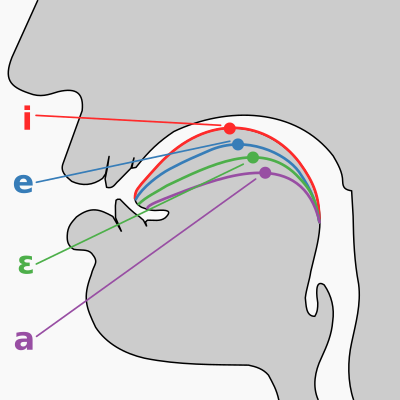
Tongue posture is perhaps the most overlooked aspect of prolonged pacifier use. A healthy tongue at rest should rest against the roof of the mouth, with the tip positioned just behind the front teeth. When a child relies on a pacifier for comfort, the tongue learns to sit in a lower position, which can become a habitual pattern that persists even after the pacifier is gone. This low tongue posture can affect swallowing patterns, speech sound development, and even breathing habits. For Kentucky families who are noticing that their child struggles with certain sounds or seems to breathe primarily through their mouth rather than their nose, addressing oral habits like prolonged pacifier use can be an important piece of the puzzle.
The good news is that age two is not too early to make a change. The American Academy of Pediatrics specifically recommends weaning from pacifiers by this milestone, and many families find that toddlers are more adaptable than they expect. If you are wondering how to approach this transition, there are several strategies that have worked well for families in our community. Some parents choose to go cold turkey, removing the pacifier entirely and offering extra cuddles and reassurance during the adjustment period. Others have had success with a gradual approach, such as cutting the tip off the pacifier so it no longer provides the same suction satisfaction, or only offering it during naps and bedtime before eventually removing it altogether.
Another approach that resonates with many young children is the idea of a trade or ceremony. Some families collect the pacifiers and let their child exchange them for a special toy or treat, framing it as a milestone of growing up. Others simply remove the pacifier once the child falls asleep, which can be an easier first step since the child is not actively craving it in that moment. Whatever method feels right for your family, consistency and patience are key. It is completely normal for there to be a few difficult nights during the transition, and offering comfort in other ways helps your child feel supported.
If you are a Louisville parent who has been wondering whether your child's pacifier habit might be affecting their oral development, I encourage you to schedule a consultation so we can discuss your specific situation. As a registered dental hygienist and myofunctional therapist, I work closely with pediatric dentists and orthodontists in the area to provide a comprehensive approach to your child's oral health. Together, we can determine whether myofunctional therapy might support your child's tongue posture, breathing, and overall oral function as they grow. Please contact our office to learn more about how we can help your family.
Tags
- pacifier weaning
- myofunctional therapy Louisville
- pediatric oral health
- tongue posture
- child dental development

About the author
Gina Sabbak, RDH
Registered Dental Hygienist · Myofunctional Therapist
Gina is a Louisville-based registered dental hygienist and myofunctional therapist. She works with children and adults on tongue posture, nasal breathing, sleep-disordered breathing, and pre/post frenectomy support.
Reviewed by Gina Sabbak, RDH ·
Book an evaluationKeep reading
Related posts
October 5, 2026
How Posture Affects Breathing: What Louisville Families Need to Know
Discover the surprising link between how you stand and how you breathe, and why myofunctional therapy in Louisville addresses both.
Read more →September 27, 2026
Why 'Just Braces' Doesn't Fix Crowded Teeth for Life
Discover why orthodontic treatment alone often fails to provide lasting results and how myofunctional therapy addresses the hidden causes of crowded teeth.
Read more →September 14, 2026
Breathing Retraining: Why Nose Breathing Matters for Louisville Families
Nasal breathing filters, humidifies, and produces nitric oxide—benefits mouth breathing simply can't match. Discover how retraining transforms health.
Read more →Have we worked with your family?
If anything here sounds familiar, Gina can help. Book a free consult.
Get in touch →