
tongue-tie
Tongue-Tie vs Lip-Tie: What's the Difference?
Understanding the distinction between tongue-tie and lip-tie can help Kentucky families make informed decisions about their child's oral health and breastfeeding journey.
By Gina Sabbak, RDH · · 3 min read
In this article
- 01.What to do next: If you would like to learn more about how myofunctional therapy can support your family, I invite you to contact us to schedule a consultation. Together we can discuss your child's unique situation and explore the options available to help them thrive.
As a myofunctional therapist with over a decade of experience working with families in Louisville and across Kentucky, I often meet parents who are confused about the terms tongue-tie and lip-tie. These two conditions are related but affect different parts of the mouth, and understanding the distinction can help you better advocate for your child's needs.
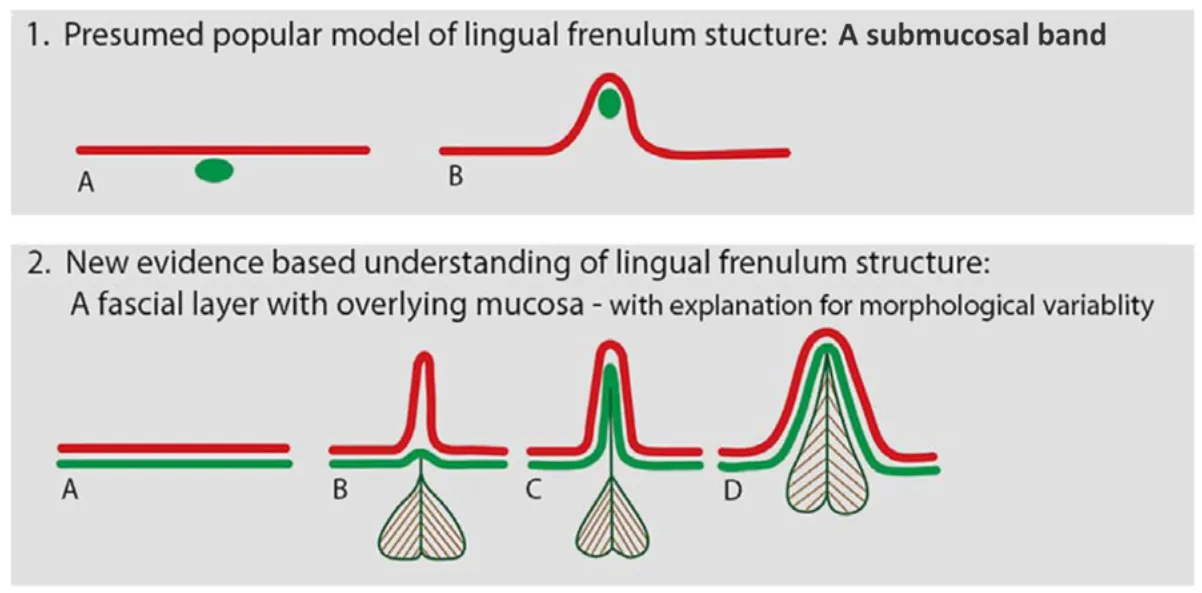
Let me start with tongue-tie, which is formally called ankyloglossia. This condition occurs when the lingual frenulum, the small band of tissue that connects the underside of the tongue to the floor of the mouth, is unusually tight, short, or thick. When this tissue restricts the movement of the tongue tip, a child may have difficulty lifting the tongue, extending it past the lips, or moving it from side to side. You might notice this when your baby cannot create a proper seal during breastfeeding or when an older child struggles to clean food from the teeth or pronounce certain sounds.
Lip-tie, on the other hand, involves the labial frenulum, which is the tissue connecting the upper lip to the gums above the front teeth. When this tissue is too restrictive, it can prevent the upper lip from flanging outward comfortably. In infants, this may show up as difficulty achieving a deep latch during breastfeeding because the lip cannot fold back properly. In older children and adults, a restricted upper lip can affect oral hygiene, cause gaps between the front teeth, or contribute to dental speech sounds that require lip movement.
Both conditions can impact breastfeeding, and this is often what brings many of my Louisville families into my office. Babies with tongue-tie may have trouble maintaining suction, may click or slip off the breast, or may not gain weight as expected. Babies with lip-tie may struggle to create an adequate seal, leading to excessive air intake and fussiness. Sometimes a baby has both tongue-tie and lip-tie, which can compound these challenges.
Beyond infancy, these restrictions can influence speech development and oral posture. Children with untreated tongue-tie may have difficulty articulating sounds like t, d, l, and th, which require the tongue to touch specific points in the mouth. Lip-tie can affect sounds that require the lips to come together, such as p, b, and m. Over time, altered oral mechanics can also influence jaw development and dental alignment, which is why early identification and intervention can be so valuable.
It is important to note that not every case of tongue-tie or lip-tie requires intervention. Some individuals function well with these variations and may never experience difficulties. The decision to pursue treatment depends on the degree of restriction, the symptoms being experienced, and how those symptoms are affecting feeding, speech, or oral development.
When treatment is recommended, different providers approach releases differently. Some dentists and oral surgeons perform frenectomies or frenotomies using surgical scissors or lasers, while ENTs may use similar techniques in an office setting. The approach chosen often depends on the age of the patient, the thickness of the tissue, and the provider's training. What I have found in my work with Kentucky families is that release procedures are just one piece of the puzzle. Myofunctional therapy before and after a release helps children and adults learn how to use their newly freed oral structures properly, developing new muscle patterns that support breastfeeding, speech, and healthy oral development.
If you are a parent in Louisville or anywhere in Kentucky and you suspect your child may have tongue-tie or lip-tie, the first step is to seek evaluation from a qualified provider. Lactation consultants, pediatric dentists, ENTs, and myofunctional therapists can all play a role in assessment and treatment planning. Look for someone who takes a comprehensive approach and considers how the release, if needed, will be supported with therapy to achieve lasting results.
What to do next: If you would like to learn more about how myofunctional therapy can support your family, I invite you to contact us to schedule a consultation. Together we can discuss your child's unique situation and explore the options available to help them thrive.
Tags
- tongue-tie
- lip-tie
- myofunctional therapy
- ankyloglossia
- Louisville pediatric care

About the author
Gina Sabbak, RDH
Registered Dental Hygienist · Myofunctional Therapist
Gina is a Louisville-based registered dental hygienist and myofunctional therapist. She works with children and adults on tongue posture, nasal breathing, sleep-disordered breathing, and pre/post frenectomy support.
Reviewed by Gina Sabbak, RDH ·
Book an evaluationKeep reading
Related posts
August 28, 2026
Tongue-Tie vs Lip-Tie: What's the Difference?
Many Louisville families wonder about tongue-tie and lip-tie. Learn the key differences and how they can affect your child's breastfeeding, speech, and oral development.
Read more →September 29, 2026
Tongue-Tie and Breastfeeding: A Parent's Guide
Understanding tongue-tie symptoms in babies and mothers, and how myofunctional therapy supports better feeding outcomes in Louisville families.
Read more →October 16, 2026
Does Myofunctional Therapy Help Sleep Apnea? A Louisville Therapist's Perspective
Discover how myofunctional therapy strengthens oral muscles and may support sleep apnea management for Kentucky families.
Read more →Have we worked with your family?
If anything here sounds familiar, Gina can help. Book a free consult.
Get in touch →