myofunctional therapy
After Braces: Why Your Retainer Isn't Enough to Keep Your Smile Straight
Discover why retainers only mask orthodontic problems. Learn how myofunctional therapy addresses the root cause of shifting teeth for lasting results.
By Gina Sabbak, RDH · · 4 min read

In this article
- 01.After spending months or even years in braces, there is nothing quite like the moment your orthodontist removes those brackets and hands you your retainer
- 02.For many families in Louisville and across Kentucky, this represents the culmination of a significant investment of time, money, and patience
- 03.Yet I have seen a pattern repeat itself again and again over the more than ten years I have worked with orthodontic patients in our community
- 04.That sense of accomplishment often fades when teeth begin shifting again, sometimes within just a few years of completing treatment
After spending months or even years in braces, there is nothing quite like the moment your orthodontist removes those brackets and hands you your retainer. For many families in Louisville and across Kentucky, this represents the culmination of a significant investment of time, money, and patience. Yet I have seen a pattern repeat itself again and again over the more than ten years I have worked with orthodontic patients in our community. That sense of accomplishment often fades when teeth begin shifting again, sometimes within just a few years of completing treatment. It is frustrating, it is common, and it does not have to happen.
Retainers absolutely serve an essential purpose. They hold your teeth in their new positions after braces come off, and without them, teeth will drift back toward their original alignment. This much is true, and I would never suggest that anyone skip their retainer wear. The critical issue that I want every parent and every adult who has invested in orthodontics to understand is that retainers address the symptom, not the cause. They are a mechanical solution to what is fundamentally a functional problem.
To understand why teeth shift, you have to look beyond the teeth themselves. The position of your tongue, the strength of your lips, and the way you breathe all influence whether your teeth stay where they were placed. If your tongue rests against or between your teeth instead of lifting to the roof of your mouth, it applies gentle but constant pressure that moves teeth over time. If your lips are weak and you habitually keep your mouth open, that changes the balance of forces on your dental arch. If you breathe through your mouth instead of your nose, the positioning of your tongue and the development of your facial structures are affected. These are the patterns that caused your teeth to be misaligned in the first place, and they do not magically disappear just because the braces came off.
Here is what I see happening in my practice with Louisville families. A teenager completes orthodontic treatment, wears their retainer religiously for the first few months, and then gradually starts wearing it less often. Within a year or two, they notice their teeth shifting. The family assumes the orthodontist did something wrong, or they blame the teenager for not wearing the retainer enough. But the truth is more nuanced than that. The retainer is doing its job by holding the teeth in place while it is being worn. However, the moment that retainer comes out, the underlying muscle patterns are still at work, gently nudging teeth back toward their old positions. It is like bailing water out of a boat without fixing the hole in the hull.
This is where myofunctional therapy makes all the difference
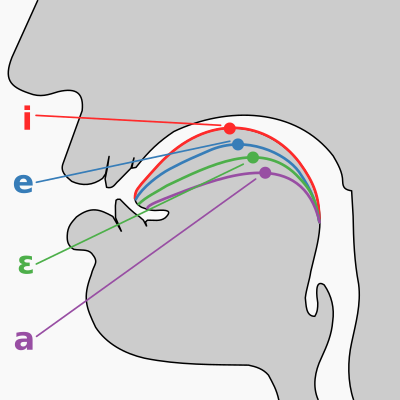
Myofunctional therapy is a specialized practice that focuses on retraining the muscles of the face, tongue, and mouth to function correctly. It addresses tongue posture, lip strength, and breathing patterns in a systematic way. When we work with patients who have completed orthodontic treatment, we are not moving teeth. We are changing the functional habits that determine where teeth want to go. By teaching the tongue to rest in the correct position, by strengthening the lips so they can maintain a proper seal, and by encouraging nasal breathing, we create an environment inside the mouth that supports the orthodontic results rather than works against them.
The results I have seen in our Louisville practice have been genuinely transformative. Patients who commit to myofunctional therapy after braces find that their teeth stay in place with far less reliance on their retainers over time. They report feeling more confident because they understand why their teeth moved and what they can do to prevent it. For parents, there is a particular peace of mind in knowing that their child is not just wearing a retainer to hold their smile in place but is actually addressing the underlying issue that caused the misalignment in the first place.
I want to be clear that myofunctional therapy does not replace orthodontic treatment. If you or your child still need braces, please continue working with your orthodontist. What myofunctional therapy does is work alongside orthodontics to create results that last. It is an investment in the long-term stability of that beautiful smile you have worked so hard to achieve.
If you are a parent in Louisville or the surrounding
Kentucky area and your child is approaching the end of their orthodontic treatment, I encourage you to think beyond the retainer. Ask questions about why teeth moved in the first place and what can be done to address those patterns. If you are an adult who had braces years ago and have noticed your teeth shifting, know that it is not too late to make a positive change. The principles of myofunctional therapy can benefit patients at any age.
What to do next: If you are curious about how myofunctional therapy can protect and stabilize your orthodontic investment, I invite you to contact us. We offer consultations where we can discuss your specific situation, answer your questions, and help you understand the options available to you. Your smile deserves more than a temporary fix. It deserves a solution that addresses the root cause, and that is exactly what we are here to provide.
Tags
- myofunctional therapy
- orthodontic retention
- Louisville dentist
- tongue posture
- breathing habits

About the author
Gina Sabbak, RDH
Registered Dental Hygienist · Myofunctional Therapist
Gina is a Louisville-based registered dental hygienist and myofunctional therapist. She works with children and adults on tongue posture, nasal breathing, sleep-disordered breathing, and pre/post frenectomy support.
Reviewed by Gina Sabbak, RDH ·
Book an evaluationKeep reading
Related posts
September 27, 2026
Why 'Just Braces' Doesn't Fix Crowded Teeth for Life
Discover why orthodontic treatment alone often fails to provide lasting results and how myofunctional therapy addresses the hidden causes of crowded teeth.
Read more →September 30, 2026
What Does a Healthy Swallow Really Look Like?
Discover the signs of a proper swallow pattern and why it matters for your family's oral health in Louisville.
Read more →September 29, 2026
Tongue-Tie and Breastfeeding: A Parent's Guide
Understanding tongue-tie symptoms in babies and mothers, and how myofunctional therapy supports better feeding outcomes in Louisville families.
Read more →Have we worked with your family?
If anything here sounds familiar, Gina can help. Book a free consult.
Get in touch →